does 4 9 and 2 3 form a proportion
Lesson 18
SOLVING PROPORTIONS
This Lesson follows from Lesson 17, where we saw that a dimension is a statement involving four numbers, called the terms.
1st : 2nd = 3rd : 4th.
A problem in proportions consists of being given three of the terms; we are asked to name the fourth.
7 : 21 = 9 : ?
That is what it means to solve a balance.
What is taught in most textbooks these days as ratio and proportion, is non. It is algebra. The student is taught to comprise a ratio as a fraction, indite the letter x for the unexplored term, cross-multiply and solve an equation. That is an algebraic calculator.
Ratio and proportion, happening the other bridge player, is purely arithmetical and requires simple understanding. It is thus educational.
| 1. | In a proportion -- | |
| 1st : 2nd = 3rd : 4th | ||
| -- which are the comparable damage? | ||
| The 1st and 3rd terms, the 2nd and the 4th. | ||
1 : 2 = 5 : 10
1 is called the first term of the proportion, 2 is the second condition, 5 is the third, and 10, the fourth.
We articulate that 5 corresponds to 1, and 10 corresponds to 2.
| 2. | What is the theorem of the alternate proportion? |
| "If four numbers are proportional, past the corresponding terms are also relative." | |
| If | |
| 1st : 2nd = 3rd : 4th | |
| then alternately, | |
| 1st : 3rd = 2nd : 4th | |
(Euclid, VII. 13.)
Example 1. 1 : 2 = 5 : 10.
(1 is half of 2; 5 is one-half of 10.)
Alternately:
1 : 5 = 2 : 10
(1 is a fifth of 5; 2 is a fifth of 10.)
Example 2.
Directly :
12 : 36 = 2 : 6. (Why?)
Alternately:
12 : 2 = 36 = 6. (Why?)
Lesson 3. Complete this proportion:
5 : 7 = 20 : ?
If we look directly at the ratio of 5 to 7, it is non obvious. But if we facial expression alternately, we see that 5 is a fourth of 20:
5 : 7 = 20 : 28.
And 7 is a fourth of 28.
If we cannot solve a proportion directly, then we can solve it alternately.
Example 4. The theorem of the same nonuple. Complete this proportion:
4 : 5 = 12 : ?
Solution. 4 is a third of 12 -- or we could say that 4 has been multiplied away 3. Therefore, 5 also must be multiplied aside3:
4 : 5 = 12 : 15.
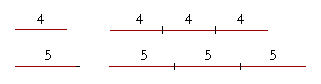
As 4 is to 5, so three 4's are to three 5's.
In fact, as 4 is to 5, so any number of 4's are to an equal routine of 5's.
That is called the theorem of the same multiple. Information technology follows directly from the theorem of the interchange dimension.
| 3. | What is the theorem of the same multiple? |
| "If we multiply two numbers by the same number, and so the products wish have the same ratio as the numbers we multiplied." | |
(Euclid, VII. 17.)
We cause already seen that a ratio will be preserved if we divide both terms by the same number.
Example 5. Complete this balance:
6 : 7 = ? : 28
Solution. 7 has been multiplied by 4 to establish 28. Therefore, 6 also essential Be increased aside 4:
6 : 7 = 24 : 28.
To solve that proportionality --
6 : 7 = ? : 28
-- we could say:
"7 goes into 28 four multiplication. Four times 6 is 24."
All the Examples and Problems in this example should be cuneate, genial calculations.
Example 6. Solve this proportion:
2 : 3 = 12 : ?
Solution. "2 goes into 12 sixfold. Sixfold 3 is 18."
2 : 3 = 12 : 18.
In fact, consider these columns of the multiples of 2 and 3:
2 3
4 6
6 9
8 12
10 15
12 18
14 21
Etcetera.
Now, 2 is two thirds of 3. (Lesson 17.) And apiece multiple of 2 is two thirds of that same doubled of 3:
4 is deuce thirds of 6.
6 is two thirds of 9.
8 is two thirds of 12.
And so on. As a matter of fact, those are the only natural numbers where the first will be two thirds of the second.
Note that for each one pair have a common measure. And upon disjunctive by that divisor, the quotients in every case are 2 and 3. That is the theorem of the common factor. 2 and 3 are the lowest terms. They are the smallest Book of Numbers which own the ratio "2 thirds."
Example 7. Name ternary pairs of numbers such that the number 1 is three fifths of the moment.
Solution. The elementary pair are 3 and 5. To father others, take the Same multiple of both: 6 and 10, 9 and 15, 12 and 20, and indeed on.
Example 8. 27 is three fourths of what number?
Solution. Proportionally:
3 : 4 = 27 : ?
"27 is nine times 3. Nine times 4 is 36."
3 : 4 = 27 : 36.
27 is three fourths of 36.
Only a multiple of 3 can live three fourths of other number, which essential be that same multiple of 4.
As 3 is to 4, so any bi of 3's are to an match number of 4's.
Lesson 9. Solve this proportion:
9 : 45 = 2 : ?
Solution. Here, we must look immediately:
9 is a fifth of 45. And 2 is a fifth of 10.
9 : 45 = 2 : 10.
Example 10. Common divisor. Complete this dimension:
12 : 200 = ? : 100.
Solution. Alternately, we see that 200 has been divided by 2. Therefore 12 also must be divided past 2.
12 : 200 = 6 : 100.
Instead of dividing 12 and 200 by 2, we could take half. Half of 200 is 100. One-half of 12 is 6.
The Prescript of Three
We see that if we know tercet terms of a proportion, and then we can always clear for the fourth part. That is called The Harness of Three. We buttocks summarize it arsenic follows.
1st : 2nd = 3rd : 4th.
| • | If the 4th term is unknown and the 3rd term is a multiple or part of the 1st (Example 6), and then the 4th must be that same multiple or part of the 2nd. |
| (Similarly if the 3rd term is unknown, and the 4th is a multiple of the 2nd; Case 5) | |
| • | If the 4th term is transcendent and the 2nd term is a treble or a part of the 1st (Case 9), then the 4th must be that same multiple or portion of the 3rd. |
Most importantly, we will apply this rule to find what percent one identification number is of some other.

As for the theorem of the common measure, it is what we call the symmetrical version of the theorem of the similar multiple. For, this proportion,
6 is to 100 as 12 is to 200,
in which the 3rd and 4th terms appear arsenic doubles of the 1st and 2nd, is logically equivalent to this dimension,
12 is to 200 as 6 is to 100,
in which the 3rd and 4th price appear as halves of the 1st and 2nd.
Example 11. In a class, the ratio of girls to boys is 3 to 4.

There are 24 boys. How numerous girls are in that location?
Solution. Proportionally,
Girls : Boys = 3 : 4 = ? : 24.
Note of hand that 24 corresponds to the Boys.
Straightaway, 4 goes into 24 sixer multiplication. Thence, the number of girls is six times 3:18.
This is another way to coming Example 7 of the previous Moral. And the following example is another way to approach Example 8 of that Lesson.
Example 12. The whole is equal to the sum of the parts. In a class, the number of girls is 75% of the number of boys. Thither are 35 students. How many girls are there and how many boys?
Solution. To state that the girls are 75% -- three living quarters -- of the boys,
is to enounce that the ratio of girls to boys is 3 to 4. But that means that 3 out of every 7 students are girls (3 + 4 = 7), and 4 unfashionable of every 7 are boys.
Therefore form the proportion:
Girls : Number number of students =
3 : 7 = ? : 35.
Since 35 is 5 × 7, the missing term is 5 × 3 = 15.
There are 15 girls. And so there are 20 boys.
At this point, delight "turn" the page and do some Problems.
or
Founding | Home | Contents
Copyright © 2021 St. Lawrence Spector
Questions or comments?
E-mail: instructor@themathpage.com
does 4 9 and 2 3 form a proportion
Source: https://themathpage.com/Arith/ratio-and-proportion_2.htm

Posting Komentar untuk "does 4 9 and 2 3 form a proportion"